The governing body’s main role is to establish a strategic framework for the school and to regularly review the progress made.
The governing body should fulfil its strategic role by taking three key actions which are to set:
- aims and objectives for the school;
- policies for the school to achieve those aims and objectives; and
- targets by which they can measure progress towards the aims and objectives.
It is very important that the governing body monitors and evaluates progress. To do this successfully they need to act as a ‘critical friend’ to the headteacher.
Acting as a ‘critical friend’
The governing body provides the Headteacher and staff with support, advice and information, drawing on its members’ knowledge and experience. In these ways the governing body acts as a ‘critical friend’ to the school.
The diagram below describes four very different positions governing bodies might take. It is important, however, that governing bodies strike a balance between support and challenge, providing strategic leadership and acting as a ‘critical friend’ to the headteacher. An effective governing body will undoubtedly provide strategic leadership combined with a high degree of challenge and high levels of support.
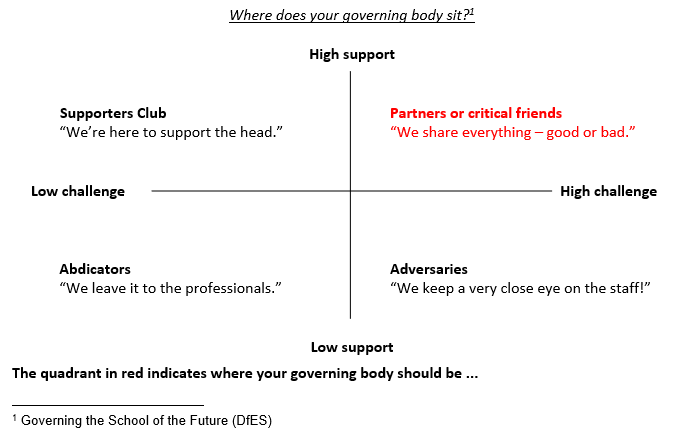
What is a ‘critical friend’?
The term ‘critical friend’ is hard to define – ‘questioning friend’ might be more appropriate. The governing body operates as a ‘critical friend’ in helping the school and its staff with actions and decisions which affect all aspects of school life and its work. In doing so, the governing body should seek out and question the reasoning behind the decisions and offer, where possible, careful and considered feedback.
Although governing bodies should provide support, they must not be afraid to ask challenging questions and seek further information or clarification when necessary. Remember the word ‘critical’ is used in the sense of the governing body’s responsibility for monitoring and evaluating the school’s effectiveness and the continual striving for improvement.
How can a ‘critical friend’ help with school improvement? Here are some points to consider:
- being a good listener and problem solver can help the school improve ideas and proposals and reach sound decisions;
- asking searching questions that help develop expectations and intentions, particularly when expectations are too low or actions do not match intentions. Sometimes, those key but often ‘simple’ questions: Why? How? Where? When? will give you the answer you need. Further information is available in part 3 of the Handbook for School Governors about the role of the governing body;
- recognising and celebrating the achievements of the school;
- knowing where the school is not achieving as well as it could;
- providing support and encouragement when strategies to bring about improvement are being explored. Systems should be in place to monitor and evaluate the work of the school;
- striking an appropriate balance between support and challenge.
The suggested questions concentrate on specific areas ranging from support and challenge, strategic overview, monitoring and evaluation, accountability and will assist in preparing for an Estyn inspection.
The ‘critical friend’ checklist and suggestions for training
Open and trusting working relationships between the governing body and staff are at the heart of the ‘critical friend’ role.
If you are setting up a governing body development/training session, think about sharing one with the staff – one on Roles and Responsibilities will help you to look at relationships within the governing body. You might want to consider ways of working with the governors and staff together. Examples could include joint sessions on looking at the vision for the school, governors’ visits to schools, or the School Development Plan.
Being well informed will help you develop the confidence to ask challenging questions.
There is a variety of training and support available for school governors to assist you in carrying out your role effectively. Training linked specifically to school priorities and the needs of individual governors will be of benefit. Many courses will help you concentrate on monitoring particular areas of governing body responsibility e.g.
The Curriculum, Safeguarding Children, Health and Safety.
Once your strategic framework for school improvement is in place, it is important to monitor its implementation and evaluate its impact.
Courses on
School Self-Evaluation/review, monitoring and evaluating will help you to develop the skills to monitor and evaluate effectively and will assist you in asking the right questions. A session on
Sharing a Vision for the School will provide a good opportunity for the whole governing body and staff to reflect on how the school’s vision and aims can be monitored in practice.
The Governor Guide on Self-Evaluation provides further detailed information.
To monitor and evaluate effectively, you must be aware of the range of information available to help you know and understand your school.
Attending training on
School Data will make you more aware of how to use information for the benefit of the children in your school. Likewise, information on
Pastoral Support will help you to understand the non-academic side of school life. The headteacher’s report to the governing body is also a useful tool to provide information on these and other areas. Further information can be found in the
Governor Guide on the Use of Performance Data
Governing bodies are responsible for the educational achievement of every pupil in their school.
How inclusive are the policies agreed by your governing body? Training e.g. on
Inclusion,
Equality and
Complaints Procedures are all areas that will help you ask the right questions to ensure that the needs of individuals are met in your school.
Many governing bodies delegate specific responsibilities to individual governors.
Link Governors should find out more about the potential of their role. Governors linked to Special Educational Needs as well as nominated child protection governors will find it useful to make sure they attend courses on
SEN and
Child Protection. If you are a new governor, or feel your understanding of the governor role needs to be updated, the mandatory Induction training will help you. A governing body development session on
Roles and Responsibilities will provide a holistic view of delegation of responsibilities on the governing body, and the governor guide on
The Appointment of Headteachers and Deputy Headteachers is essential information for the panel delegated to carry out the selection process for a new headteacher or deputy headteacher. If you are likely to sit on a pupil exclusion panel then make sure you attend appropriate training opportunities.
Staff are your most valuable asset and the governing body which is a good ‘critical friend’ will take their well-being seriously.
Sessions on
Performance, Pay and Progression will help you to monitor the provision you make for all your staff.
Governing bodies need a clear structure to help them monitor and evaluate the impact of their policies effectively.
It is useful to have a checklist for this purpose. A template is provided as well as a list of
statutory policies and documents required
Governing bodies need to understand how the financial systems in their school work, if they are to ensure that the budget is put to best use in delivering priorities for improvement.
Training sessions on
Finance will be able to help you here.
A governing body also needs to monitor and evaluate its own performance if it is to remain effective.
A whole governing body self-evaluation/review exercise is a useful way of reviewing governing body practices and is an excellent tool to prepare for an inspection, linked specifically to the School Evaluation report, and will assist in ensuring that the governing body is performing effectively in its leadership role. In addition, chairs will find it helpful to attend specific sessions to assist in developing the skills they need to best support and lead the governing body. Likewise, an effective clerk is key to effective governance – make sure that your clerk is aware of specific training or development opportunities. Further information can be found in the
Governor Guide on Self-Evaluation
Remember – you can’t all do it all! But if every member of your governing body is committed to training for one aspect of your work, you will be making good use of the time you have available give to your school.
Questions for Governors to ask the Headteacher/leadership team in their support and challenge role
A vital part of the role of school governors is providing effective support and challenge for their headteachers and senior leaders. In order to assist governors in that role, the
National Leadership Development Board (NLDB) has drawn up the following key questions for governors to use.
CLICK HERE
For more tips and effective practice to assist you with your important support and challenge role and being the critical friend, take a look at our elearning module.
© Governors Cymru Services
Published: 29/08/2018

